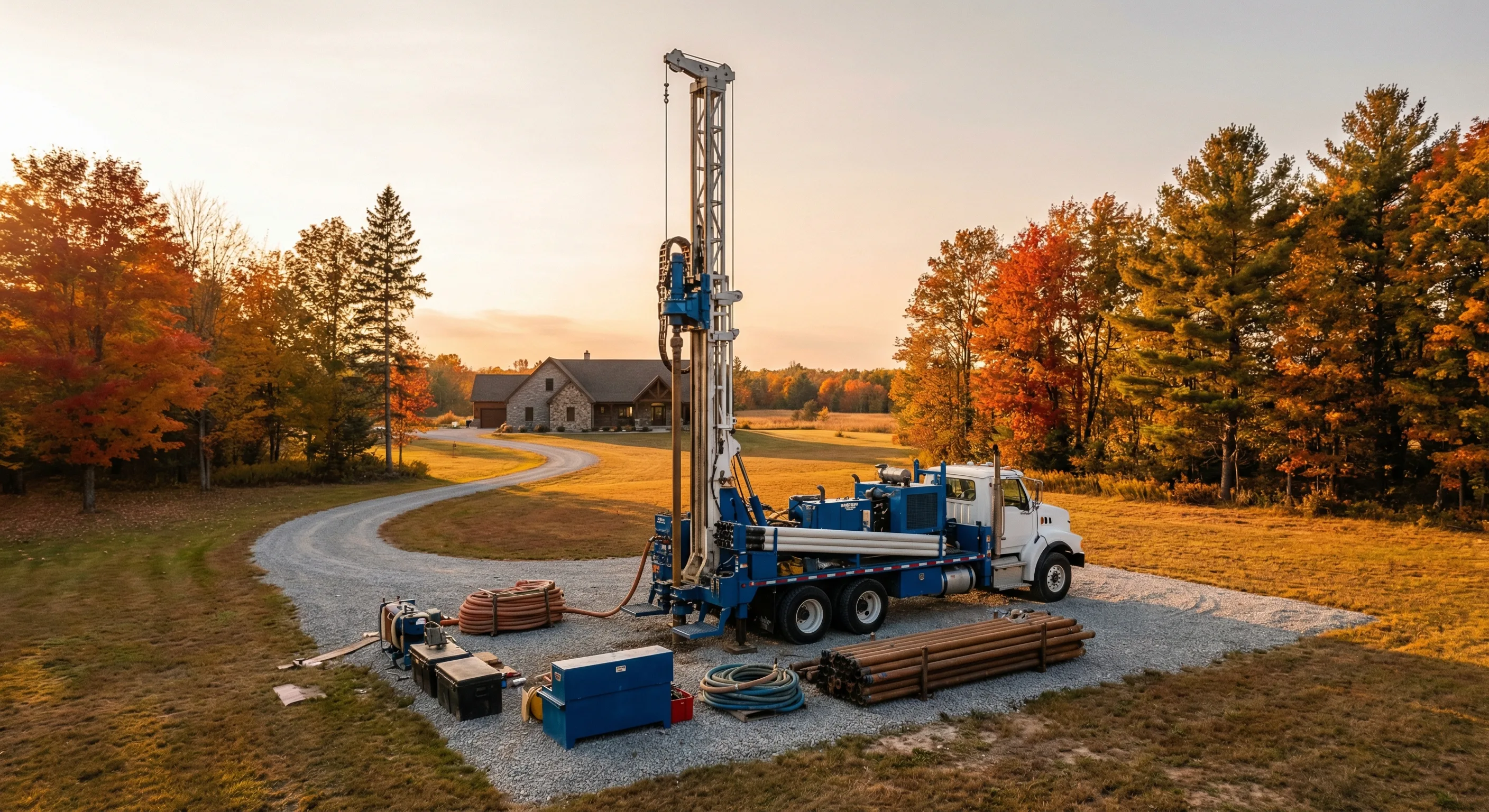
Well Installation & Completion in Tiny Township
Professional well installation services for Tiny Township homes, farms, and businesses.
Well installation in Tiny Township centres on the challenge of completing wells properly in shallow bedrock with minimal overburden. The thin veneer of sandy glacial material over limestone and dolostone means that casing-in-rock grouting is the standard installation technique for virtually every well in the township. The casing must be seated into competent, unfractured bedrock below the weathered surface zone, and the annular space sealed completely to prevent surface water from reaching the drinking water aquifer through near-surface fractures. This seal is even more critical in Tiny Township than in areas with thick overburden because there is essentially no natural soil filter between the surface and the rock. Beyond the casing seal, Tiny Township installations must also address the seasonal nature of many properties. Cottage communities along the Georgian Bay shoreline including Balm Beach, Bluewater Beach, Woodland Beach, and Georgian Sands are occupied primarily from spring through fall. The well system for these properties needs to support easy winterization and spring start-up, with drain-back capability and accessible valve placement. UV disinfection is a standard recommendation for Tiny Township installations due to the thin overburden and fractured bedrock aquifer. We configure the UV system to operate automatically whenever water flows, providing continuous protection with no homeowner intervention required during the season.
Well Installation Services We Provide in Tiny Township
Well Casing & Screening
Installation of steel or PVC well casing to the required depth, with stainless steel screens sized to match the aquifer formation. Proper casing protects the well from collapse and prevents surface water from entering the borehole. Screen slot sizes are selected based on the grain size of the aquifer material to maximize yield while preventing sand production.
Well Development
After casing and screening are installed, the well must be developed to remove drilling mud, fine sediment, and disturbed formation material from around the screen. We use surging, jetting, and controlled pumping techniques to clean the well bore and establish a natural gravel pack around the screen, maximizing long-term yield and water clarity.
Sealing & Grouting
Annular sealing with bentonite or cement grout fills the space between the well casing and the borehole wall. This seal prevents surface water, shallow groundwater, and contaminants from migrating down the outside of the casing into the aquifer. Ontario Regulation 903 specifies minimum sealing depths and material requirements that we follow rigorously on every installation.
Pitless Adapter Installation
A pitless adapter provides a sanitary, below-frost-line connection between the well casing and the horizontal water line running to your building. This eliminates the need for a well pit, which is no longer permitted under Ontario regulations due to contamination risk. We install pitless adapters at a depth of at least five feet to protect against freezing in Simcoe County winters.
Common Well Installation Issues in Tiny Township
Achieving a reliable casing seal in weathered shallow bedrock
The upper bedrock surface in Tiny Township is often weathered and fractured from thousands of years of freeze-thaw action. Seating casing in this zone is risky because the grout can escape through fractures and the weakened rock may not hold the casing securely. A poor seal leaves the well vulnerable to surface contamination.
Our Solution: We advance the casing below the weathered zone into fresh, competent rock before grouting. Our drillers identify the transition from weathered to competent rock by monitoring the drill performance and cuttings character. The casing is seated firmly and the annular space is grouted from bottom to top with neat cement designed for rock applications. We track grout volume to verify complete fill.
Minimal depth available for pitless adapter on bedrock properties
With bedrock often within one to two metres of the surface in Tiny Township, installing a pitless adapter at the standard frost-protection depth can be impossible using conventional methods. The adapter needs to be in the casing below frost depth, but there may not be enough casing above bedrock to accommodate it.
Our Solution: We use several approaches depending on the specific site conditions. Options include extending the casing above bedrock level and backfilling around it to create adequate depth, installing an insulated well pit, or using a casing extension with the adapter set within the extended section. Each method maintains frost protection while working within the shallow bedrock constraint.
Stagnant water in seasonal cottage wells promoting bacterial growth
When cottage wells sit unused for four to six months through winter, the standing water in the well, piping, and equipment becomes stagnant. Bacteria can establish and multiply in this still water, making the first water drawn in spring potentially unsafe without treatment.
Our Solution: We install UV disinfection as a standard component of seasonal Tiny Township well systems. The UV unit treats water at the point of entry each time a tap is opened, eliminating bacteria that may have established during the dormant period. We also include system flushing in the spring start-up protocol to physically remove stagnant water before regular use begins.
Include UV Disinfection in Your Tiny Township Cottage Well Budget
When budgeting for your cottage well in Tiny Township, include UV disinfection as a line item alongside the pump and pressure tank — treat it as essential equipment, not an optional upgrade. The shallow fractured bedrock common throughout the township provides less natural protection than deep soil cover elsewhere. A UV system running continuously during the cottage season provides peace of mind that your family water is safe. Annual lamp replacement is the only maintenance required.
Need Well Installation in Tiny Township?
Call us for a free phone consultation or request a site visit. We're your local experts.
Well Installation in Tiny Township: Frequently Asked Questions
Why is UV disinfection recommended for every Tiny Township well?
How do you complete a well in shallow bedrock at Balm Beach?
Can you install a well system that is easy to winterize for my Tiny Township cottage?
What happens to the pump during winter in a seasonal Tiny Township well?
How much does a complete well installation cost in Tiny Township?
Other Services We Provide in Tiny Township
Beyond well installation, we offer a full range of well and water services in Tiny Township:
We Also Provide Well Installation in Nearby Areas
Serving communities across Simcoe County and Grey County from our home base in Stayner.
Serving Tiny Township and Surrounding Areas
Ready to Get Started in Tiny Township?
Contact our experienced team for a free consultation and estimate. Over 60 years of trusted service.