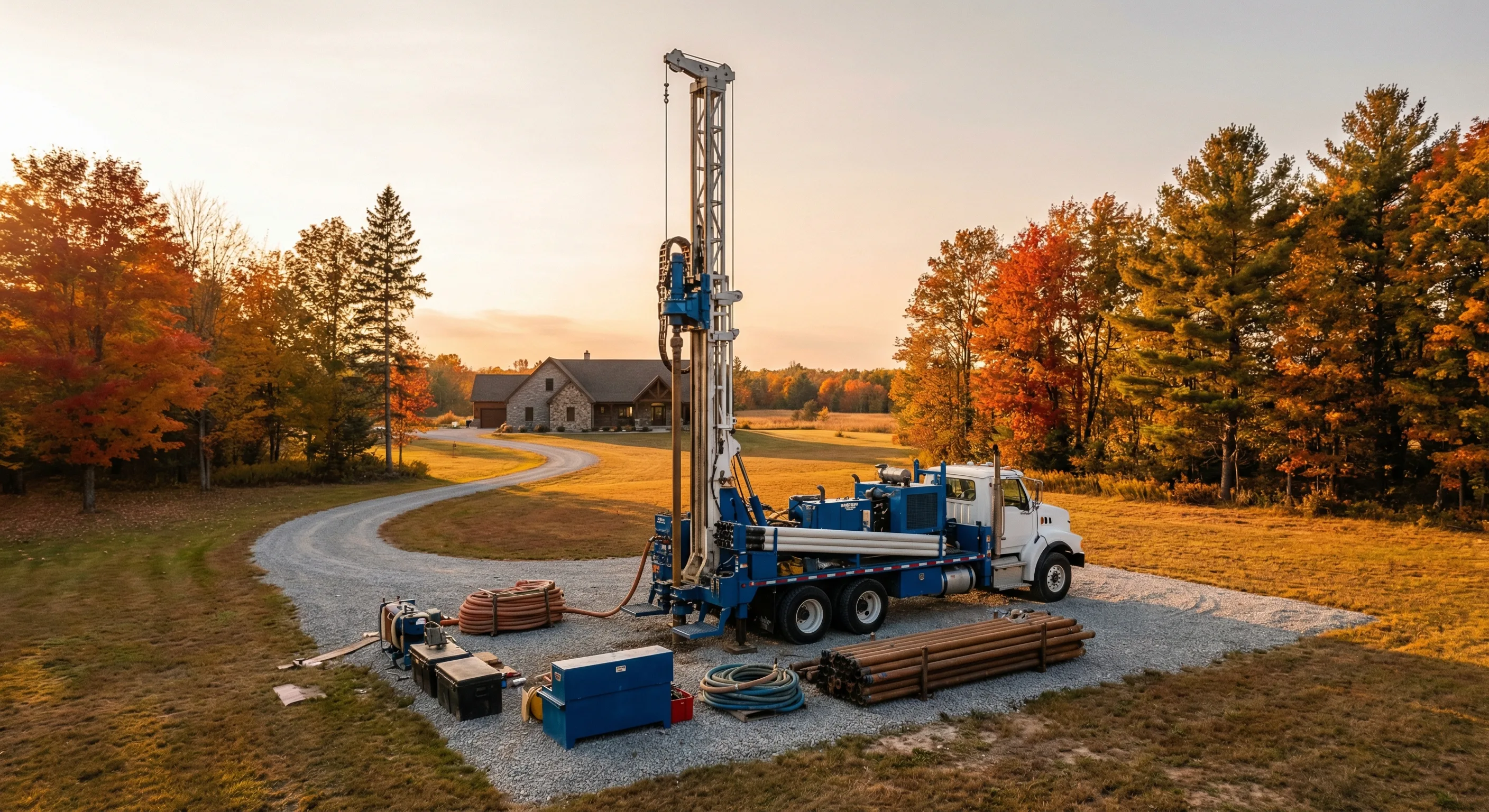
Well Installation & Completion in Mulmur Township
Professional well installation services for Mulmur Township homes, farms, and businesses.
Well installation on the elevated Niagara Escarpment plateau in Mulmur Township centres on achieving a reliable casing-in-rock seal in the shallow limestone bedrock and setting the pump at adequate depth to account for the deeper water tables found at higher elevations. The thin overburden typical of Mulmur means that the casing is seated into bedrock within the first few metres, and the grouting must bond the steel casing securely to the surrounding rock to prevent any surface water from tracking down into the aquifer. The cement grout must fill every void between the casing and the sometimes-irregular rock surface, and we verify completeness by monitoring grout volume against the calculated annular space. Below the cased section, the borehole continues through limestone and dolostone as an open hole, with the productive fractures that supply water occurring at various depths. The deeper water table associated with Mulmur elevated position means the pump must be set further down in the well than would be necessary at lower elevations, requiring longer drop pipe and heavier-gauge wiring. The pitless adapter installation can be complicated by the shallow rock, and we use specialized approaches to ensure a frost-protected connection regardless of how close the bedrock is to the surface. The rural, somewhat remote character of Mulmur means that every well installation must be done right the first time — these properties depend entirely on their wells, and service response times are longer than in more populated areas. We ensure every Mulmur installation is built to a standard that minimizes the likelihood of future problems.
Well Installation Services We Provide in Mulmur Township
Well Casing & Screening
Installation of steel or PVC well casing to the required depth, with stainless steel screens sized to match the aquifer formation. Proper casing protects the well from collapse and prevents surface water from entering the borehole. Screen slot sizes are selected based on the grain size of the aquifer material to maximize yield while preventing sand production.
Well Development
After casing and screening are installed, the well must be developed to remove drilling mud, fine sediment, and disturbed formation material from around the screen. We use surging, jetting, and controlled pumping techniques to clean the well bore and establish a natural gravel pack around the screen, maximizing long-term yield and water clarity.
Sealing & Grouting
Annular sealing with bentonite or cement grout fills the space between the well casing and the borehole wall. This seal prevents surface water, shallow groundwater, and contaminants from migrating down the outside of the casing into the aquifer. Ontario Regulation 903 specifies minimum sealing depths and material requirements that we follow rigorously on every installation.
Pitless Adapter Installation
A pitless adapter provides a sanitary, below-frost-line connection between the well casing and the horizontal water line running to your building. This eliminates the need for a well pit, which is no longer permitted under Ontario regulations due to contamination risk. We install pitless adapters at a depth of at least five feet to protect against freezing in Simcoe County winters.
Common Well Installation Issues in Mulmur Township
Deep pump setting due to elevated water table depth
The high elevation of Mulmur Township means the water table sits deeper relative to the surface than in lowland areas. This requires the pump to be set deeper in the well, increasing the length of drop pipe and wiring and the pump horsepower needed to lift water the greater distance.
Our Solution: We calculate the total dynamic head for each Mulmur well including the static water level, drawdown, pipe friction, and pressure system requirements. The pump is sized specifically for this combined head to deliver adequate flow at the required pressure. All drop pipe connections are checked and wiring gauge is verified for the increased length to prevent voltage drop that could harm the motor.
Irregular rock surfaces making casing seat and grout seal challenging
The bedrock surface in Mulmur is not always smooth — it can be irregular, with ridges, pits, and fracture openings that create an uneven annular space around the casing. Standard grouting may not fill these irregular voids completely, potentially leaving pathways for surface water.
Our Solution: We seat the casing in a section of rock that is as competent and regular as possible, advancing past any severely fractured or irregular zones. The grout is placed from the bottom using a tremie pipe, and we use a slightly more fluid initial mix to penetrate irregular voids before switching to a standard consistency above. Volume monitoring confirms that all irregularities have been filled.
Frost protection for pitless adapter in very shallow bedrock
With bedrock often within a metre of the surface in Mulmur, conventional pitless adapter installation at frost depth is sometimes physically impossible. The rock prevents excavation to the required depth around the casing.
Our Solution: We employ several alternative approaches: casing extensions that raise the pitless adapter position above the bedrock level with insulated backfill, insulated and heat-traced piping sections where the water line must pass through the frost zone in rock, or insulated well pits constructed into excavated bedrock. The specific solution depends on the site conditions, and every approach is designed to prevent freeze-ups during the cold Mulmur winters.
Ensure Your Mulmur Well Equipment Is Rated for the Depth
Because Mulmur wells often have deeper pump settings than wells in surrounding lowland areas, make sure every component is rated for the actual depth. This includes the pump horsepower, the wire gauge for the motor cable, the drop pipe strength rating, and the torque arrester. Undersized components for a deep well lead to voltage drop that burns out pump motors, weak pipe connections that fail under the weight of the water column, and poor performance. We size everything for the specific depth of your well — accept nothing less.
Need Well Installation in Mulmur Township?
Call us for a free phone consultation or request a site visit. We're your local experts.
Well Installation in Mulmur Township: Frequently Asked Questions
Why does the pump need to be set deeper in Mulmur Township wells?
What happens if the bedrock is too close to the surface for a pitless adapter?
How do I know the casing seal is good on my Mulmur escarpment well?
What maintenance does a Mulmur Township well need after installation?
Are there Niagara Escarpment Commission requirements for well installation in Mulmur?
Other Services We Provide in Mulmur Township
Beyond well installation, we offer a full range of well and water services in Mulmur Township:
We Also Provide Well Installation in Nearby Areas
Serving communities across Simcoe County and Grey County from our home base in Stayner.
Serving Mulmur Township and Surrounding Areas
Ready to Get Started in Mulmur Township?
Contact our experienced team for a free consultation and estimate. Over 60 years of trusted service.