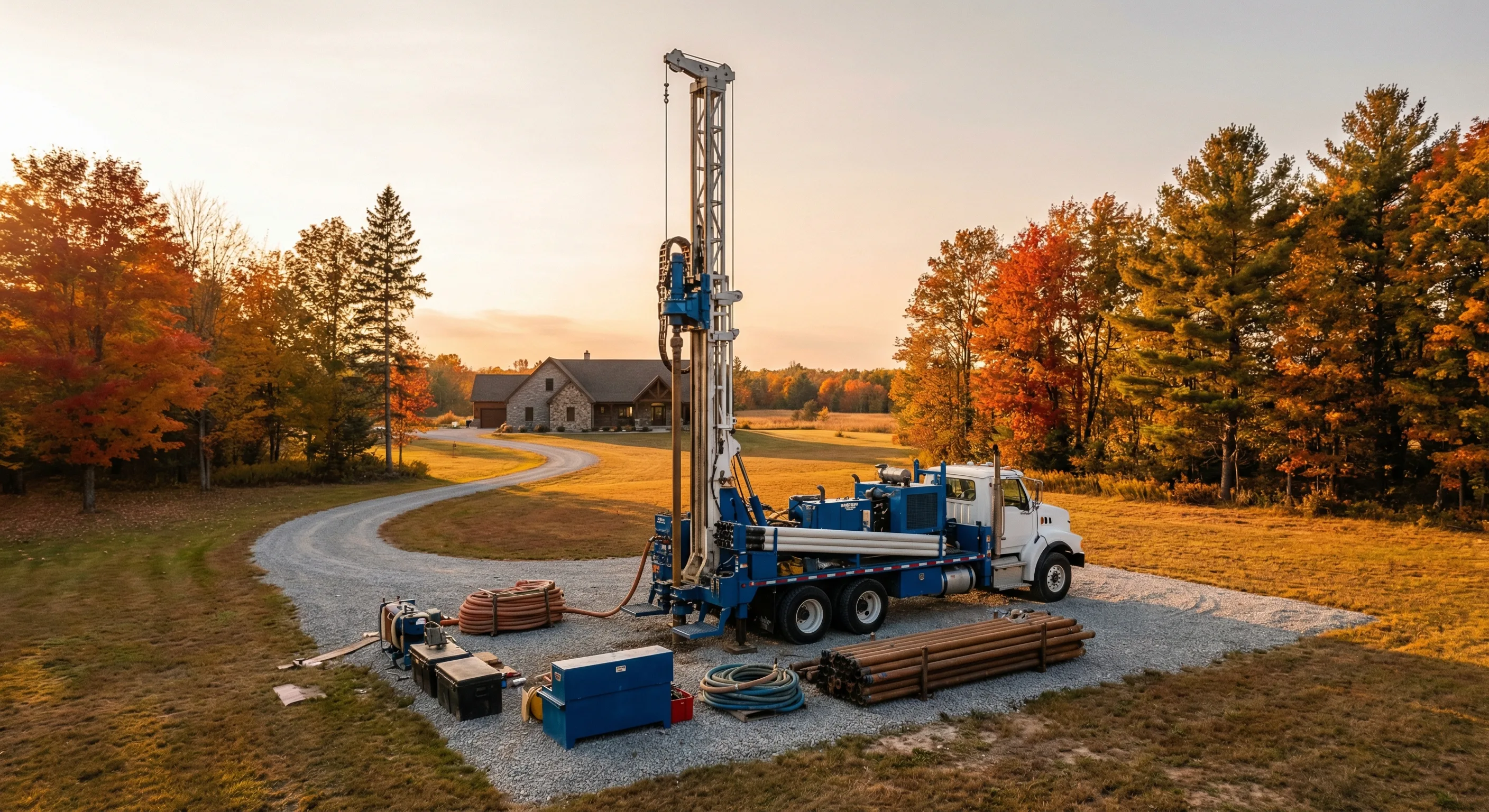
Professional Well Drilling Services in Simcoe County
Clean, reliable water starts with a properly drilled well.
Mighton's Well Services has been drilling water wells across Simcoe County and the surrounding region for over 60 years. As a family-owned company based in Wasaga Beach, we understand the unique geological conditions that define this part of Ontario — from the sandy glacial deposits along the Nottawasaga River valley to the limestone bedrock formations found throughout Clearview and Essa Townships. This local expertise allows us to select the right drilling method and well design for every property we work on.
We employ both Rotary and Cable Tool drilling methods, choosing the approach best suited to subsurface conditions at your site. Rotary drilling is highly effective in the consolidated rock formations common across much of Simcoe County, while Cable Tool methods are preferred in unconsolidated sand and gravel aquifers where preserving formation integrity matters. For wells completed in gravel and rock aquifers, we install stainless steel screens that resist corrosion and provide decades of reliable service — a critical consideration given the naturally occurring iron and manganese found in many local groundwater supplies.
Every well we drill is constructed in full compliance with Ontario Regulation 903, which governs well construction standards across the province. This regulation sets strict requirements for casing depth, annular sealing, surface protection, and setback distances from potential contamination sources. Our licensed well technicians ensure that your new well meets or exceeds all regulatory standards, and we file the required well record with the Ministry of the Environment upon completion. Whether you need a residential well for a new home build, a high-capacity commercial or agricultural well, or an environmental monitoring well, our experienced crew delivers dependable results backed by six decades of local knowledge.
Our drilling methodology begins with a thorough review of existing well records in the Ontario well database for properties near your site, which helps us anticipate the formations we will encounter and estimate the depth needed to reach a productive aquifer. On drilling day, our crew arrives with a truck-mounted drill rig, support equipment, and all necessary casing and materials. As we drill, we continuously log the geological formations — recording changes in soil type, rock hardness, colour, and water-bearing zones. This drilling log becomes part of the permanent well record and is invaluable for future maintenance decisions. Once we reach a productive aquifer, the well is cased, screened where appropriate, sealed with bentonite or cement grout, and developed by pumping until the water runs clear and free of sediment.
Seasonal timing plays an important role in well drilling projects. While we drill year-round in Simcoe County, each season offers distinct advantages and considerations. Spring and fall are popular times for new construction wells, as builders aim to have water supply established before other trades arrive on site. Summer provides the longest working days and the most predictable weather, though it is also our busiest season for emergency pump calls. Winter drilling is entirely feasible and can be advantageous — frozen ground supports heavy equipment well, reduces surface disruption to lawns and driveways, and our schedule is often more flexible, meaning faster booking times. The key consideration in winter is ensuring the pitless adapter and water line connection are completed below the frost line, which reaches four to five feet in our area.
Simcoe County's geology is remarkably diverse, shaped by glacial activity thousands of years ago, and this directly influences how we approach every drilling project. Along the Wasaga Beach corridor and south toward Barrie, thick deposits of glacial sand and gravel overlie the bedrock, often containing productive shallow aquifers that respond well to Cable Tool drilling and screen completions. In Springwater Township, heavy clay deposits can extend dozens of feet below surface, requiring us to drill through tight, low-permeability material before reaching water-bearing zones beneath. The Clearview and Blue Mountains area features fractured dolostone and limestone bedrock close to surface, where Rotary drilling excels at penetrating hard rock and intercepting water-bearing fractures. Near Barrie and Oro-Medonte, glacial till and drumlin deposits create a layered subsurface where multiple aquifer zones may exist at different depths, and selecting the right one for long-term reliability requires experience and careful evaluation.
Homeowners planning a new well should know that well drilling is not a guaranteed-depth process — the depth of your well depends on where the productive aquifer lies beneath your specific property, which can vary even within a single neighbourhood. We provide honest estimates based on nearby well records, but the final depth and yield are determined by what we encounter underground. It is also important to understand that the cheapest well is not always the best well. Proper casing, quality stainless steel screens, thorough annular sealing, and complete well development all add cost but dramatically extend the life and reliability of your water supply. A well built to high standards today will serve your family for decades with minimal issues, while shortcuts in construction often lead to expensive repairs, contamination problems, or premature well failure down the road. We encourage homeowners to be present during drilling if possible — our crew is happy to explain what we are finding underground and answer questions as the work progresses.
What's Included
Residential Well Drilling
New water well drilling for homes and cottages across Simcoe County. We work with builders and homeowners to site wells properly, considering setback distances from septic systems, property boundaries, and potential contamination sources as required by Ontario Regulation 903. Our residential wells typically range from 40 to 200 feet depending on local geology.
Commercial & Industrial Well Drilling
High-capacity well drilling for businesses, farms, campgrounds, golf courses, and industrial applications. Commercial wells require careful hydrogeological assessment to ensure sustainable yield without impacting neighbouring water supplies. We coordinate with hydrogeologists and the Ministry of the Environment for Permit to Take Water (PTTW) applications when required.
Monitoring Well Installation
Environmental monitoring wells for groundwater quality assessment, contamination investigations, and site remediation projects. We construct monitoring wells to MOE specifications using appropriate materials and screen intervals to accurately represent groundwater conditions at the target depth zone within the aquifer.
How It Works
Site Assessment & Well Siting
We visit your property to evaluate geological conditions, identify the optimal well location based on regulatory setbacks, accessibility for drilling equipment, and proximity to the home or building. We review existing well records in the area to estimate expected depth and yield.
Drilling
Using Rotary or Cable Tool methods based on site geology, we drill through overburden and into the aquifer-bearing formation. We log the geological formations encountered and identify the most productive water-bearing zone for well completion.
Well Completion & Casing
We install steel or PVC casing to the required depth, set stainless steel screens where appropriate, and seal the annular space with bentonite or cement grout to prevent surface contamination from reaching the aquifer. A vermin-proof well cap is installed at surface.
Development & Testing
The well is developed by surging and pumping to remove drilling fluids and fine sediment, maximizing water flow from the aquifer. We conduct a pump test to measure the well yield and determine the appropriate pump size. The well record is filed with the Ministry of the Environment.
Common Problems We Solve
Low Well Yield
Some areas of Simcoe County, particularly those with dense clay overburden or tight bedrock formations, can produce wells with marginal yield that may not meet household demand during peak usage.
Our Solution: We use hydrofracturing to open existing fractures in bedrock and improve water flow. In some cases, drilling a deeper or secondary well may be recommended. Storage tanks with trickle-charge systems can also supplement low-yield wells.
Hard Water & Mineral Content
Groundwater in much of Simcoe County passes through limestone and dolomite formations, picking up calcium, magnesium, iron, and manganese. This results in hard water that causes scale buildup and staining.
Our Solution: Proper well construction with stainless steel screens helps, but water treatment is often needed. We can recommend and install softening systems, iron filters, and other treatment equipment tailored to your water chemistry.
Artesian Conditions
In certain areas — particularly low-lying zones near the Nottawasaga River and in parts of Tiny and Springwater Townships — drilling can encounter artesian pressure where groundwater flows naturally to surface.
Our Solution: Our crews are experienced in controlling artesian flow during drilling. We use proper casing techniques and pressure seals to manage flowing wells safely while maintaining compliance with Ontario Regulation 903 requirements for artesian well construction.
Surface Water Contamination Risk
Shallow wells or wells with inadequate surface sealing can allow bacteria, nitrates, and other contaminants from surface runoff, septic systems, or agricultural activity to reach the water supply.
Our Solution: We ensure every well has proper casing depth, annular sealing to below the frost line and beyond any vulnerable zones, and a secure well cap. For existing wells with contamination issues, we assess whether rehabilitation or replacement is the best course of action.
Have a Well Drilling Question?
Our experienced team is ready to help. Call for a free phone consultation or request a site visit.
Frequently Asked Questions About Well Drilling
How deep will my well need to be in Simcoe County?
What is the difference between Rotary and Cable Tool drilling?
How long does it take to drill a well?
Do I need a permit to drill a well in Ontario?
What happens if the driller does not find water?
Why do you use stainless steel well screens?
Can you drill a well in winter in Ontario?
How far must a well be from my septic system?
What is the average cost of drilling a well in Simcoe County?
How much water will my well produce?
Well Drilling Across Simcoe County & Grey County
We provide well drilling services across 19 communities within a 50km radius of our home base in Stayner. Whether you're in Wasaga Beach, Barrie, or Collingwood, our team has the local knowledge and experience to deliver reliable results.
Related Services
Well Drilling often goes hand-in-hand with these other services we provide:
Ready to Get Started With Well Drilling?
Contact our experienced team for a free consultation and estimate. Over 60 years of trusted service.