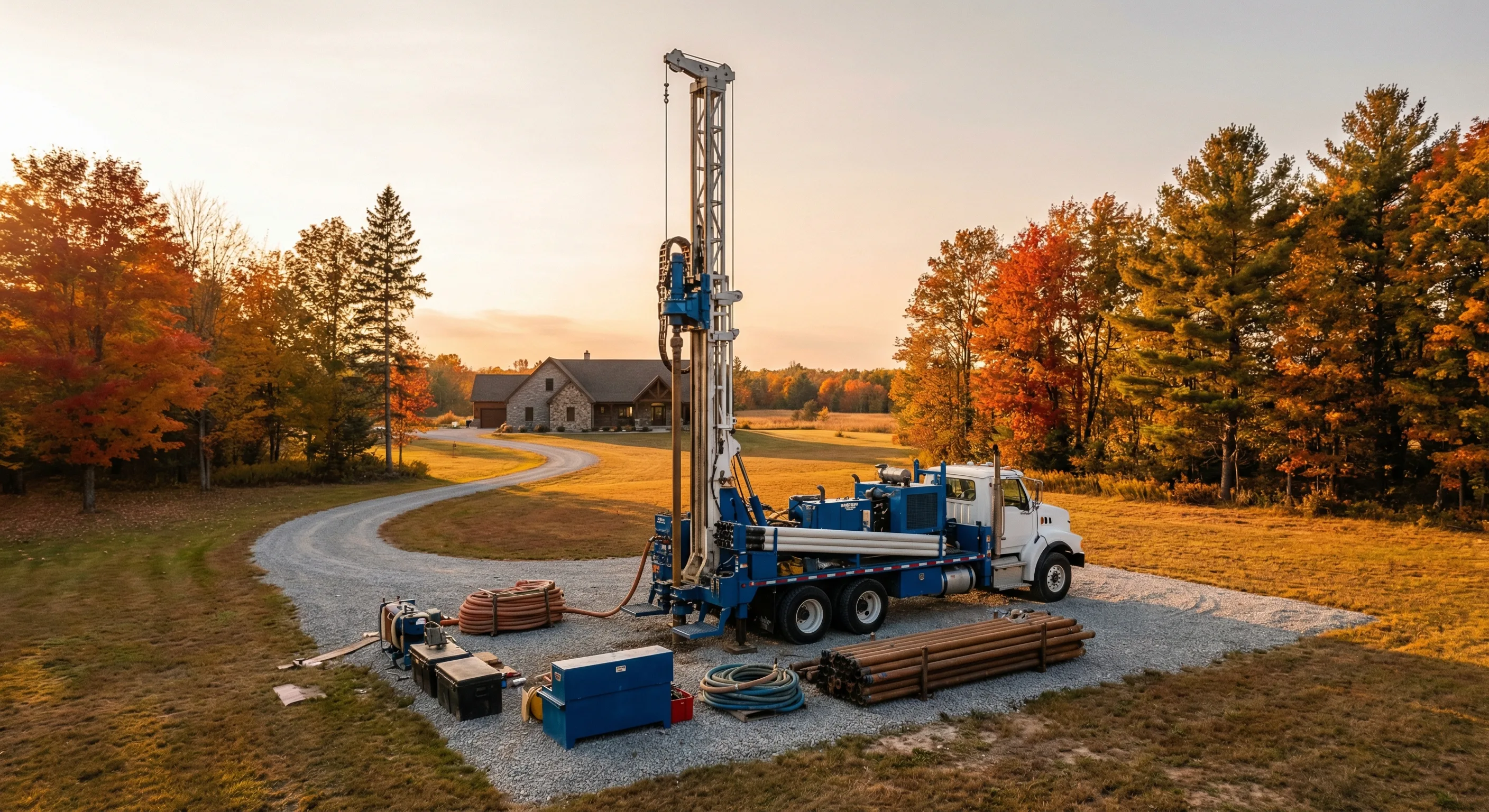
Pump & Pressure System Services in Springwater Township
Professional pump systems services for Springwater Township homes, farms, and businesses.
Springwater Township's thick clay till geology creates pump and pressure system challenges that centre on managing fine sediment, protecting equipment from turbidity, and working within the yield constraints of clay-confined aquifers. Pumps in Springwater wells must handle water that often carries microscopic clay particles — not enough to visibly clog the system immediately, but enough to cause progressive wear and fouling of sensitive components over time.
Clay particles in the water column affect every part of the pressure system. They settle in the pressure tank, coat the bladder surface, accumulate in check valve seats, and deposit in the pressure switch sensing port. Unlike sand, which is heavy and settles quickly, clay particles are so fine that they remain suspended in the water and circulate through the system repeatedly before settling out. This persistent suspension means that traditional sediment filters alone may not be adequate — the filtration system must be designed for the specific particle size range found in Springwater's clay till groundwater.
The yield characteristics of clay-confined aquifers in Springwater also require thoughtful pump design. These aquifers often have limited recharge rates, meaning the pump can easily overdraw the well during sustained demand. Our installations in Springwater include yield-matching pump controls, generous pressure tank sizing to minimize pump cycling, and filtration systems designed to remove clay-sized particles effectively without excessive pressure drop or frequent maintenance.
Pump Systems Services We Provide in Springwater Township
Submersible Pump Installation
Installation of submersible well pumps sized to match your well yield, depth, and household demand. Submersible pumps sit inside the well casing, submerged below the water level, and push water to the surface. We install pumps from leading manufacturers with stainless steel construction for long life in the mineral-rich groundwater common throughout Simcoe County.
Jet Pump Installation
Jet pumps are surface-mounted units suitable for shallow wells up to 25 feet deep (single-line) or up to 90 feet (dual-line). They are common in older installations and certain applications where surface access to the pump is preferred. We install, repair, and convert jet pump systems, and can advise when upgrading to a submersible pump would improve performance and reliability.
Pump Repair & Replacement
Diagnosis and repair of pump failures including motor burnout, impeller wear, check valve failure, electrical faults, and control system malfunctions. When repair is not cost-effective, we provide complete pump replacement using properly sized equipment. We pull and reinstall submersible pumps with our service rig and can typically restore your water supply the same day.
Pressure Tank Installation
Pressure tanks store pressurized water and reduce the number of pump start cycles, extending pump motor life. We install and replace bladder-style pressure tanks in sizes matched to your pump capacity and household demand. Waterlogged or failed tanks cause rapid pump cycling — a common service call that we can resolve quickly with a properly sized replacement.
Common Pump Systems Issues in Springwater Township
Clay sediment fouling pressure system components
Microscopic clay particles from Springwater's till deposits pass through the well screen and circulate through the pressure system. They coat the pressure tank bladder, settle in the tank bottom, deposit on check valve seats causing leakage, and clog the pressure switch sensing port. The cumulative effect degrades system performance over months and years.
Our Solution: We install a multi-stage filtration system sized for clay particle removal — typically a spin-down sediment separator followed by a cartridge filter with appropriate micron rating. The pressure tank is equipped with a flush valve for periodic sediment removal. Pressure switch and check valve maintenance at regular intervals keeps these sensitive components functioning properly.
Pump cycling issues from limited aquifer recharge rate
Springwater's clay-confined aquifers recharge slowly because the surrounding clay restricts water movement. A pump that runs at a rate exceeding the aquifer's recharge capacity will rapidly draw the well down, triggering the low-water cutoff or causing the pump to draw air. The pump then waits for the well to recover, creates a brief burst of flow, and repeats — a frustrating cycle for the homeowner.
Our Solution: We size the pump to match the well's tested sustained yield rather than peak demand, and install a larger-than-standard pressure tank to provide household-side volume during demand peaks. For properties with high demand and limited well yield, a cistern storage system with a trickle-fill pump accumulates water continuously and feeds a separate delivery pump for the house.
Turbidity affecting UV disinfection and water treatment
Many Springwater properties use UV disinfection for bacterial protection, but clay turbidity in the water reduces UV transmittance, potentially allowing bacteria to pass through the system without adequate exposure. Treatment systems designed for clear water underperform in turbid conditions.
Our Solution: We ensure that sediment filtration upstream of the UV system reduces turbidity to the manufacturer's specified maximum — typically below 1 NTU. A properly staged filtration system with a turbidity monitoring option provides confidence that the UV system is receiving water clear enough for effective disinfection. Pre-filtration also protects other treatment equipment from sediment fouling.
Size Your Springwater Pump to the Well's Yield, Not the House's Demand
The most common pump sizing mistake in Springwater Township is choosing a pump based solely on household demand without considering the well's limited recharge rate. A pump that delivers ten gallons per minute is useless if the well only produces three. The pump will cycle on and off constantly, the low-water cutoff will trigger repeatedly, and the well will never be able to keep up. Start with the well yield as the hard constraint, then use pressure tank sizing and storage to bridge the gap between what the well produces and what the house needs.
Need Pump Systems in Springwater Township?
Call us for a free phone consultation or request a site visit. We're your local experts.
Pump Systems in Springwater Township: Frequently Asked Questions
Why does my Springwater pump system need more maintenance than my neighbour's in another area?
What type of filter is best for Springwater's clay water?
How do I prevent my pressure tank from filling with clay sediment?
Can a constant pressure system help with my Springwater well's limited yield?
My pump keeps shutting off on the low-water cutoff — what should I do?
Other Services We Provide in Springwater Township
Beyond pump systems, we offer a full range of well and water services in Springwater Township:
We Also Provide Pump Systems in Nearby Areas
Serving communities across Simcoe County and Grey County from our home base in Stayner.
Serving Springwater Township and Surrounding Areas
Ready to Get Started in Springwater Township?
Contact our experienced team for a free consultation and estimate. Over 60 years of trusted service.